




BSIM
Meval Rose Sebastian
Q: What made you want to share your breastfeeding journey?
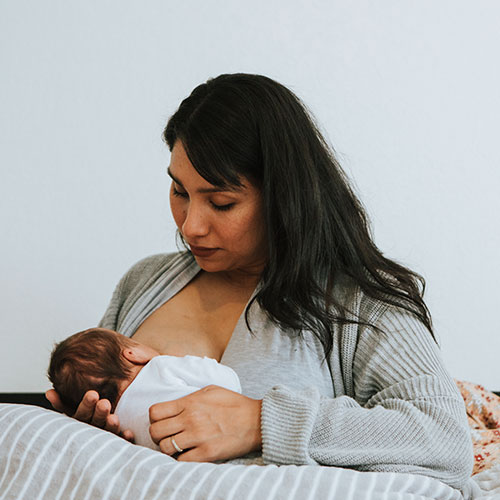
I wanted to share my story to give hope to mothers who are struggling to transition their babies from expressed milk bottles to direct breastfeeding. I know how difficult and heartbreaking it can feel when nothing seems to work, especially when you desperately want that connection with your baby.
Q: Can you tell us about your baby’s early days and birth experience?
My little one is now over 4 months old. She was born weighing 2.950 kg via C- section and was admitted to the NICU for the first 4–5 days due to tachypnea,
which is quite common in C-section babies. Because I was still recovering, she was initially fed formula. Once I was able, my colostrum was expressed and given to her. Since she wasn’t with me in the NICU, I began expressing milk regularly. She took 2–3 direct feeds per day, while the rest were expressed breast milk (EBM) and formula.
Q: When did the breastfeeding challenges begin?
She was reluctant to latch directly after her discharge from the NICU. We were told to use a nipple shield, and while it helped at first, she would become cranky and not stay latched for very long. I had to use a bottle to top off with EBM every time. The doctor recommended giving 45–60 ml of extracted milk per feed when her weight gain was slower than anticipated, and I completely quit direct breastfeeding. She did not even return to her birth weight by three weeks in spite of this.
Q: Were there any medical complications later on?
Yes, unfortunately. Even though she had normal urine and stool output and no fever, her neonatologist at Al Ahalia Hospital, Musaffah, Abu Dhabi, suspected an
infection. She was diagnosed with UTI, sepsis, and meningitis and was admitted to the NICU for 3.5 weeks.
Those were extremely difficult days.
Q: How did feeding work during that time?
During her illness, she was losing weight, so I had to exclusively pump and feed her through bottles. The doctors advised adding Human Milk Fortifier (HMF) to my expressed milk to increase calorie intake. I am deeply grateful to the neonatologist because she never pushed formula feeding. Instead, she encouraged me to continue pumping and fortify my own milk.
Q: What happened after discharge from the NICU?
After discharge, we continued adding HMF until her weight improved. By around 10 weeks, we were advised to stop the fortifier. However, by then, my baby had developed a strong preference for the bottle. Even though she was growing, deep down, I always longed for her to nurse directly. Every attempt I made failed, and each failure was emotionally exhausting.
Q: What all did you try to get her back to the breast?
Honestly, I tried everything.
Paced bottle feeding with slow-flow nipples
Nipple shields
Lots of skin-to-skin contact
Supplemental Nursing System (SNS)
Cup feeding
Spoon feeding
Paaladai (gokarnam)
Filler
Nothing worked.
Q: Was there a turning point in your journey?
Yes, the guidance from lactation consultants made a huge difference. A lactation consultant at Aster Medicity, Cochin, told me that latching might only be possible initially with a nipple shield, and we would need to wean it later. She also emphasized that to reduce bottle preference, we must avoid the “sucking satisfaction” of bottles by using cup or spoon feeding. From a lactation consultant’s YouTube video, I learned something crucial: The mother should not be the one offering cup or spoon feeds. This was a game changer.
Q: What strategy finally worked?
This time, my mother-in-law helped. She offered small amounts of milk through a filler (which comes with baby medicines boxes) and cup before my baby became very hungry. My baby would take a little, then cry mildly, not out of hunger, but sleepiness. My mother-in-law would gently rock her into a half-sleep state and then bring her to me. Meanwhile, I would express a little milk to ensure good flow, fill the nipple shield so milk was already oozing and then offer the breast.
At first, on her attempt to latch, the nipple shield was falling down or get misplaced. Later, my baby latched only for a few seconds and got frustrated. We repeated this multiple times. The first 2–3 attempts were very hard, but by the end of the day, something shifted.
Q: What changed for your baby?
As my lactation consultant had predicted, she started to need comfort sucking from me rather than the bottle. She was not completely emptying the breast during the first several days, so I kept pumping after feedings to preserve supply. She began eating well with the nipple shield in a few days.
Q: How did you wean off the nipple shield?
After about two weeks, I began gently removing the nipple shield mid-feed, especially when she was sleepy or nearly full. Sometimes, I would playfully offer my bare nipple toward the end of the feed. Gradually, the time without the shield increased. Soon, she needed the shield only to start and then, one day, she accepted my bare
nipple completely. That very same day, she transitioned completely.
Q: How is your breastfeeding journey now?
Now she just completed 6 months and we started solids along with her favourite breastmilk.
She feeds calmly, happily and fully empties both breasts. She is more active, meeting milestones, and gaining weight better than when she was bottle-fed.
The peace and joy I feel today are beyond words.
Q: What message would you like to give other mothers?
To every mom who is trying please don’t lose hope.
Sometimes the journey takes longer, needs patience and needs teamwork. But progress is possible.
All the best, mamas.
You’re stronger than you think.